
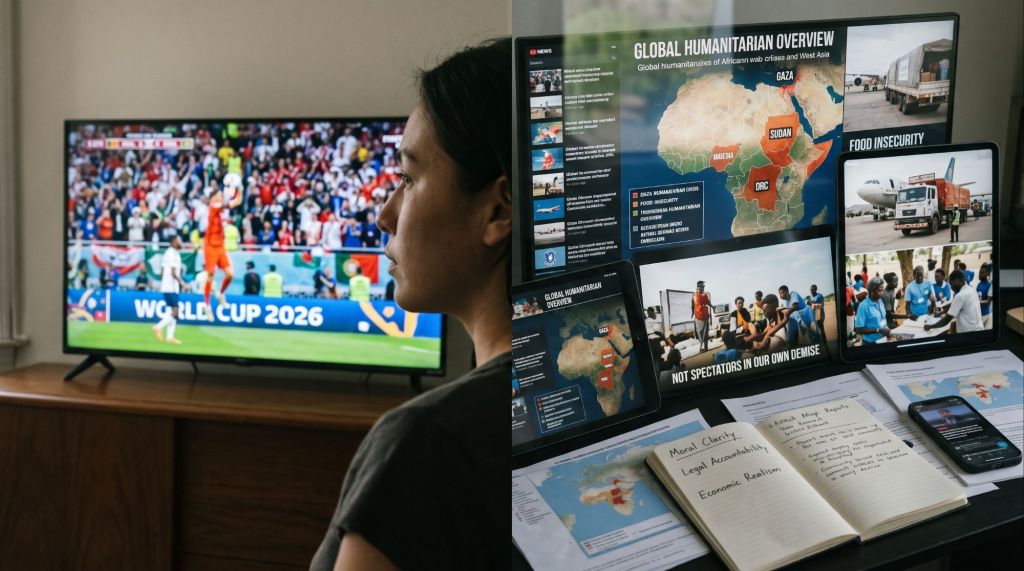
Between the FIFAWorldCup games we must keep full view of the severe crises facing more than half of humanity in 2026 and our collective responsibility to do something about these. We are not spectators in our own demise.
Africa and West Asia both entered 2025–2026 faced with the gravest convergence of crises in modern history.
As others have said before me, this is not a moment for poetic outrage, rhetorical solidarity or performative empathy.
It is a moment for moral clarity, legal accountability, economic realism, and political courage.
I. MORAL IMPERATIVE: A WORLD IN FREEFALL
The scale of human suffering in 2026 is unprecedented — and overwhelmingly man‑made.400 million children now live in or are fleeing from conflict zones, according to the 2025 Global Humanitarian Overview .318 million people face acute hunger in 2026 — double pre‑pandemic levels — with 41 million at Emergency or famine conditions, per the 2026 WFP Global Outlook .
Two famines have been officially confirmed in Gaza and Sudan the first time this century famine has struck two countries simultaneously .These are not just mere statistics.
They are indictments. A human generation that tolerates this level of preventable suffering is not in crisis it is in abysmal moral collapse.
II. LEGAL IMPERATIVE:
The 2026 Global Humanitarian assessments warn that wars in Iran, DRC, Gaza, Sudan, and Ukraine are marked by:“Ferocity and intensity of killing”“Complete disregard for international law”“Deliberate obstruction of humanitarian access” These are not accidents of war.They are systematic violations of the Geneva Conventions. These are acts of conscious criminality and impunity.
Meanwhile: Crises now last 10 years on average, with catastrophic impacts on life expectancy, maternal mortality, infant mortality, employment opportunities, food and nutrition security and vaccination rates. Attacks on humanitarian workers have increased sharply, with local staff facing deadly violence and obstruction .
The world is racing toward a lawless order where atrocity is normalized and accountability is either stigmatised or optional.
III. ECONOMIC IMPERATIVE:
We thought that we had made progress towards poverty eradication and reduction of inequality and all forms of discrimination. But these are back on steroids .
The 2025 World Development Indicators and the 2026 world economic outlook assessments reveal:A dramatic rise in forcibly displaced people, reaching the highest levels ever recorded by 2024, with low‑income countries hosting the largest numbers .New poverty datasets show persistent and worsening deprivation, especially in conflict‑affected regions, with poverty reduction stalling globally .Food insecurity is now structurally linked to conflict: 69% of global hunger is conflict‑driven .War is not only killing people.
It is killing economies, productivity, human capital, and future generations.Sudan alone saw humanitarian need double from 15.8 million (2023) to 30 million (2024) — a collapse without historical precedent .
IV. POLITICAL IMPERATIVE:
The world is not suffering from a lack of resources.
It is suffering from a lack of political and moral maturity, responsibility, accountability and will.Nearly 300 million people require humanitarian assistance in 2025 the highest in modern history .Humanitarian operations are underfunded, overstretched, and under assault.Climate disasters — droughts, floods, heatwaves — are hitting the world’s poorest hardest, compounding conflict and displacement.
The political systems meant to safeguard humanity are instead rewarding impunity, enabling corruption, and prioritizing militarization over human survival.
1. RECLAIMING HUMAN DIGNITY
We must reject the normalization of mass suffering.
Demand that leaders treat every life as equal whether in Iran, DRC , Gaza, Sudan, Haiti, Ukraine, Myanmar, or the Sahel.
2. END IMPUNITY
Demand independent investigations into war crimes.Sanction perpetrators of mass atrocities.Protect humanitarian workers.
Without accountability, the cycle of violence will continue indefinitely and become normalised and institutionalised into a political culture .
3. RESOURCE SURVIVAL, NOT COLLAPSE
The world needs tens of billions in humanitarian funding yet appeals remain chronically underfunded.
Underfunding is not a budget issue.
It is a political choice.Invest in:
-Social protection
-Food systems
-Peacebuilding
-Climate resilience
– Comprehensive State -Accountability and oversight reforms
Every dollar invested in anticipatory action saves seven dollars in losses, according to WFP’s 2026 analysis .
4. REBUILD THE SOCIAL CONTRACT
Citizens must demand:
-Transparent governance
-Protection of rights
-Civilian oversight of security forces
-Executive accountability
-Peace‑first foreign policy
A political order that cannot protect its people has no legitimacy.
THE NAKED TRUTH !
Poverty is not inevitable.
Hunger is not inevitable.
War is not inevitable.
Impunity is not normal governance practice .
These crises are choices made by leaders, institutions, voters , churches, mosques , political parties , businesses, and systems.They can be unmade by collective action.
History will ask one question of us:When the world was burning, did we look away —or did we act?.

